Poster Presentation

Poster presentation in ISAGBCON conference

The upcoming ISAGBCON conference at WBUAFS, Kolkata will surely be an appropriate podium for sharing scientific knowledge and innovations related to multiomics approaches for improvement of animal health and production. It is a great opportunity for the researchers to display their work in front of the luminaries of the field including academicians, researchers, technocrats, industry leaders, policymakers, practicing veterinarians, startups, and research scholars. So, participants are encouraged to upload their work as an abstract in the prescribed format and present their work in the Poster session.

Guidelines for poster presentation

 – Printable Poster Size: (Max.) 4 Feet (Height) × 3 Feet (Width) (Portrait Mode)

 – Contents should include title, authors and their Affiliations

Title: Font size 60, Cambria Bold

Authors: Font size 40, Arial MT Rounded Bold

Affiliation: Font size 36, Arial MT Rounded Bold

Body of the poster should contain following:

Abstract: Font size 36, Times New Roman

Introduction: Font size 32, Times New Roman

Methodology (in brief): Font size 32, Times New Roman

Results: Font size 32, Times New Roman

Conclusions: Font size 32, Times New Roman

References: Font size 32, Times New Roman

Note: Graphics, Tables, Images and others to be included as per requirement

(Caption for Graphics, Tables and Images, Font size 32, Times New Roman Bold Italic)

Note
  • Conference Volunteers will be onsite to assist you to put up the posters.
  • Presenters are requested to be available with the poster during the poster session timing and during review.
  • There will be awards for best posters which will be declared at the Award Ceremony function
Upload ePoster (pdf format, max. size 10 MB)

To submit your Abstract Click Here

Poster Judging Form

poster judging form

General Guidelines of Poster Presentation

[👇Click to Expand]

Over the past forty years, the poster presentation has evolved as a dynamic communication tool to meet the needs of the growing number of researchers to show their work in a scholarly manner, irrespective of discipline. Poster presentation with relevant graphics offers an excellent chance to engage in structured interactions with other scientists working in a particular domain of research. It allows for direct conversations with peers, experts, and collaborators, leading to valuable feedback, suggestions, and potential collaborations.

For researchers, including those at the highest level of their professions, poster presentation is a popular and significant means to network with others, share their work, and have debates. Even Nobel laureates, like other scientists, use posters to showcase their work, particularly when interacting with younger researchers or attending gatherings such as the Japan Society for the Promotion of Science’s (JSPS) HOPE Meeting. Like other scientific posters, posters usually serve to provide a succinct and visual storytelling of the laureate’s groundbreaking contribution to science.

How to make an attractive scientific poster?

Because there will be many different posters, participant in poster scientific session should focus on clarity, visual appeal, and a strong message. The following points should be kept in mind while preparing the posters:
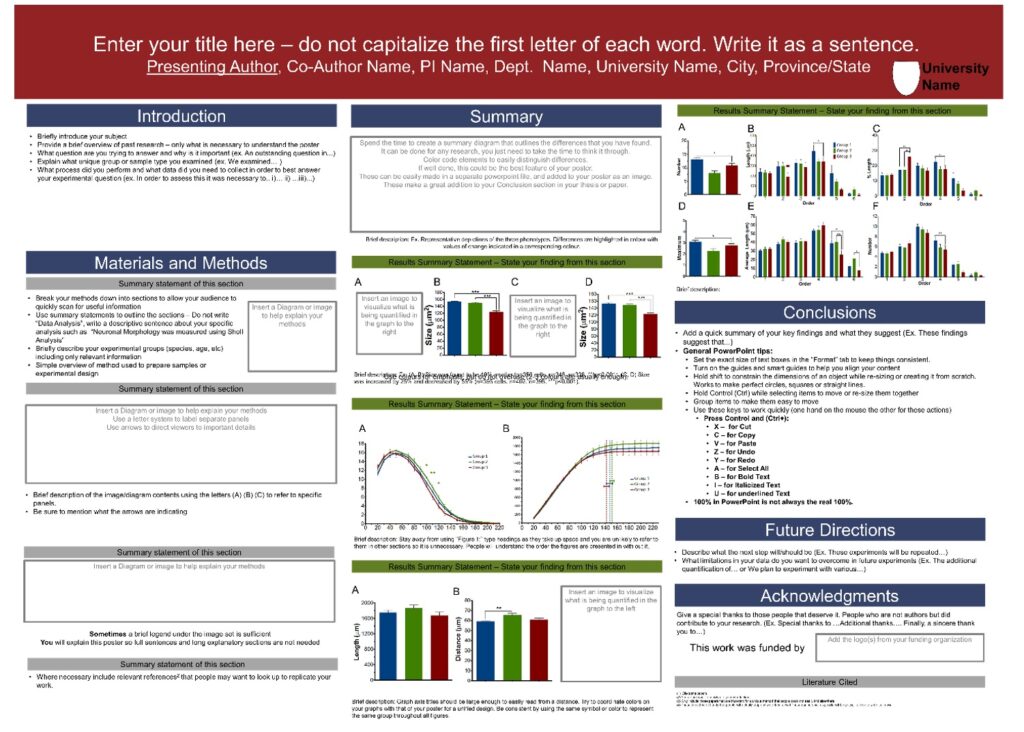
  • Planning before poster preparation:
  • Define your message:Think about the main point you want to convey through the poster.
  • Know your audience:Tailor your content and design to their interests and knowledge level. 
  • Take time to prepare: Preparing a poster takes time. Plan for a minimum of one week.


General guidelines:
  • The standard format of a poster follows that of an oral scientific presentation and includes Introduction, Methods, Results, Conclusions; Recommendations.
  • Keep it concise: Use clear, concise language, and bullet points to avoid large blocks of text. If all text is kept to a minimum (1000 words), a person should fully read your poster in less than 10 minutes.
  • Focus on key information:Highlight the most important findings and avoid unnecessary details. Use short sentences, simple words, and bullets to illustrate your points.
  • Use informative headings and subheadings: Guide the reader through your poster. 
  • Make a layout: Think of the raw layout of your poster beforehand. Place the title at the top. Start with the Introduction at the upper left, finish with the recommendations at the lower right, with methods and results filling the central space.
  • Use visuals effectively: Self-explanatory graphics should dominate the poster. The success of a poster directly relates to the clarity of your illustrations and tables
  • Use colour strategically: Bright colours can be used to highlight key information, but avoid overwhelming your audience (2-3 colours are usually enough).
  • Use a light and neutral background: This makes the text easier to read. 
  • Ensure sufficient white space: This prevents overcrowding and allows the poster to breathe. 
  • Use readable font and font size: Use a non-serif font (e.g., Arial) for the poster. The poster (text and graphics) should be easily readable from a distance of about 2 metres.
  • Proofread carefully: Ensure your text is free of errors. 
  • Title of the poster:
  • Title should be in large fonts (e.g. Arial >80 points)
  • If possible, institute logos or affiliations should be minimized in size and put in the lower corner of the poster, or, alternatively, next to the title.
  • Introduction:
  • Get your viewer interested about the issue or question while using the absolute minimum of background information and definitions.
  • Put the objectives of your study at the end of your introduction.
  • Methods:
  • Be short, but precise. State what study design you used and define your study population.
  • Mention statistical, laboratory and other methods that were used.
  • Results:
  • Present data that more specifically addresses the hypothesis and refer to supporting charts or images. Tables and graphs should stand on their own. A minimal amount of text materials should supplement the graphic materials. Use regions of empty space between poster elements to differentiate and accentuate these elements.
  • Graphic materials should be readable at a distance of 1.5-2.0 metres. The font size should be at least 1 cm high. Lines in illustrations should be larger than normal. Avoid using patterns or open bars in histograms. Remove all non-essential information from graphs and tables (data curves not discussed by the poster; excess grid lines in tables). Graphics and tables should have a complete title and legend.
  • Conclusion and recommendations:
  • Comment on main results and discuss why they are conclusive and interesting.
  • Discuss potential biases.
  • What are your recommendations?
  • Acknowledgments/further information:
  • Thank individuals for specific contributions to project; mention who has provided funding.
  • Provide your e-mail address for further information.
A format of a scientific poster
Please see these video link on how to present your poster effectively:
isagbcon icon

First Announcement-cum-Invitation International Conference of ISAGB (ISAGBCON)

Subscribe to our newsletter

Sign up to receive updates, promotions, and sneak peaks of upcoming event. Plus 20% off your next order.

Promotion nulla vitae elit libero a pharetra augue